
Dayboro Frost Risk Calculator
Live frost predictions powered by my own weather station. Local sensor data, not Brisbane guesses.
Unlike generic frost calculators that work off Bureau of Meteorology data from Archerfield or Brisbane Airport (both coastal, flat, and nothing like a valley), my tool uses data from a weather station sitting in the same microclimate as your garden. The Dayboro Model forecast I run provides 7 night predictions so I can plan ahead, while live sensor data refines tonight's risk as conditions evolve.
Frost Risk Calculator
Live frost predictions for the Dayboro valley, from my own sensor network.
Tonight's Frost Risk
What's At Risk
7-Night Frost Forecast
Unlock Full Frost Protection
Members get the complete 7 night forecast, overnight temperature curves, crop specific alerts per night, and historical frost analysis for my Dayboro station. It's what I watch every night in winter.
Join Dayboro.auOvernight Temperature Curve
Projected hourly temperatures from 6 PM to 8 AM
Crop Specific Alerts: 7 Nights
Per crop risk for each forecast night
Historical Frost Analysis
Lowest recorded overnight temperatures by month (Dayboro station data)
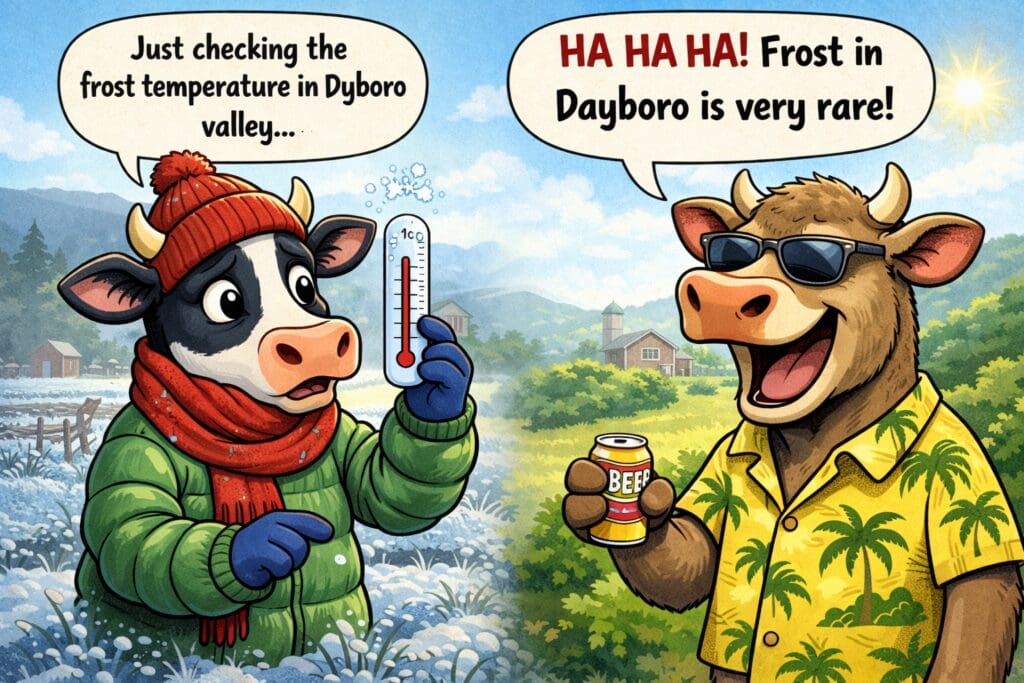
Frost season: my frost risk window is typically May to September. The lowest temperature I've recorded at my station is 3.9°C (30 August 2025). True ground level frost (0°C) has not been recorded at screen height on my block, but ground level temperatures can be 3 to 5°C lower on calm, clear nights.
Understanding frost in the Dayboro valley
I sit in a valley at approximately 130 metres elevation in the D'Aguilar foothills, about 35km north west of Brisbane CBD. This geography creates a microclimate significantly different from coastal Brisbane. Cold air drains from the surrounding ridges into the valley floor on calm, clear nights, creating frost pockets that generic weather forecasts simply cannot predict. I've watched my station drop 4°C in two hours on a still night when Brisbane was sitting steady.
The Bureau of Meteorology's nearest automatic weather station is at Archerfield, a flat coastal site at 12 metres elevation. When the BoM forecasts a minimum of 8°C for "Brisbane", my Dayboro valley can be sitting at 4 to 5°C. A critical difference for anyone with frost sensitive plants in the ground.
How the Frost Risk Score Works
The calculator computes a frost risk score from 0 to 100 using five weather factors, each weighted by its importance in frost formation:
Temperature (0–40 points)
The single largest factor. Score scales by proximity to 0°C: temperatures at or below freezing score the maximum 40 points, while anything above 13°C scores zero. The scaling is non linear. the difference between 5°C and 2°C matters far more than the difference between 12°C and 9°C.
Dew Point Depression (0–20 points)
The gap between air temperature and dew point determines whether conditions favour radiative frost or fog. A gap of 3–5°C is the "sweet spot" for frost formation (maximum 20 points) because the air is dry enough for strong radiative cooling but not so dry that frost cannot form. Very small gaps (under 1°C) indicate fog, which actually provides some frost protection by trapping heat.
Wind Speed (0–15 points)
Calm conditions allow a stable cold layer to form near the ground. Wind speeds below 2 kph score the maximum 15 points; moderate winds (10+ kph) mix warmer air downward and largely prevent frost. The Dayboro valley is naturally sheltered, so calm nights are common during winter high pressure systems.
Cloud Cover (0–15 points)
Clear skies allow maximum radiative heat loss to space. Overcast conditions act as an
insulating blanket, scoring zero. Cloud cover is parsed from the Dayboro Model forecast
text: clear = 15, partly cloudy = 10,
mostly cloudy = 4, overcast = 0.
Barometric Pressure (0–10 points)
Stable high pressure (above 1020 hPa and rising) creates the ideal conditions for radiative frost: clear skies, light winds, and dry air. Falling pressure typically indicates an approaching weather change with cloud and wind, reducing frost risk.
Crop Frost Vulnerability
The calculator includes 19 common Dayboro garden vegetables grouped by frost tolerance. These thresholds come from horticultural data calibrated against local growing experience:
| Tolerance | Crops | Damage Starts | Kill Temp |
|---|---|---|---|
| None | Tomato, Beans, Cucumber, Capsicum, Zucchini, Basil | 5°C | 2°C |
| Light | Lettuce, Potato, Coriander, Pumpkin | 2°C | −2°C |
| Moderate | Carrot, Broccoli, Cabbage, Parsley, Silverbeet | 0°C | −5°C |
| High | Spinach, Kale, Garlic, Asparagus | −3°C | −10°C |
The crop grid shows three status badges based on the forecast minimum temperature: At Risk when the minimum is at or below the crop's damage threshold, Watch when within 3°C of the threshold, and Safe otherwise. Remember: ground temperatures can be 3–5°C colder than screen height forecasts.
Limitations and Honest Reporting
No frost calculator is perfect, and this one has specific limitations you should know about:
- Frost is rare at Dayboro. the lowest we've recorded is 3.9°C. True sub zero screen temperatures are not in our observational record. This calculator will correctly show "Negligible" for most of the year (October through April).
- Dew point not in forecast data. the Dayboro Model forecast does not include a direct dew point prediction. We estimate overnight dew point using the fog indicator as a proxy: "moderate fog" means dew point equals the minimum temperature; no fog means dew point is approximately 5°C below the minimum.
- Cloud cover is text, not numeric. parsed from the forecast conditions string ("partly cloudy," "overcast," etc.). Edge cases in forecast wording may occasionally be misclassified.
- Hyper local variation. the weather station is at a single point in the valley. Your property's frost exposure depends on its specific elevation, aspect, proximity to creek lines, and surrounding vegetation.