
8 Free Vegetable Garden Planning Tools for Every Australian Climate
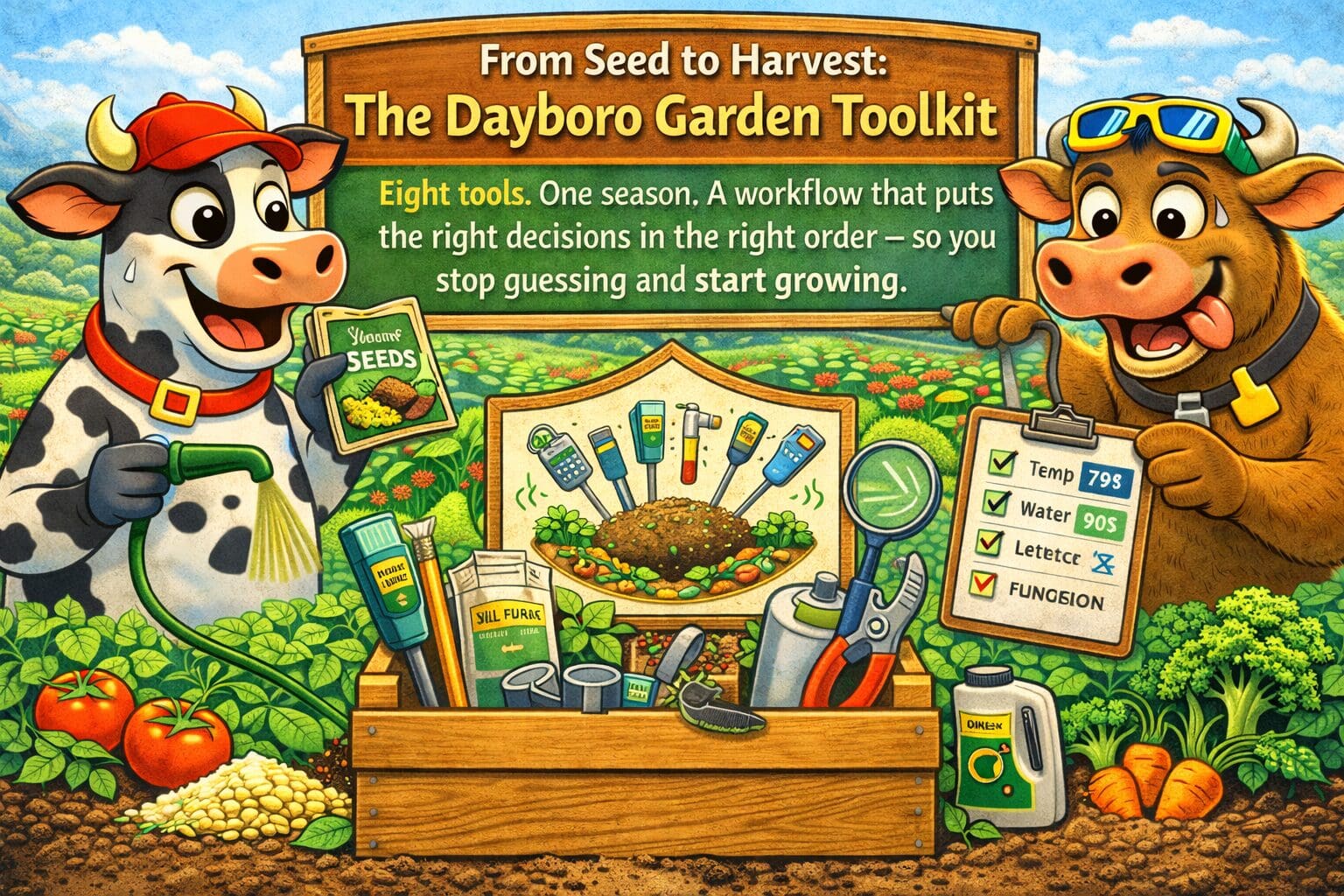
Eight tools. One season. A workflow that puts the right decisions in the right order — so you stop guessing and start growing.
If you've killed two rounds of seedlings, blamed the weather, blamed the soil, and quietly blamed yourself — you're probably not doing it wrong. You're just making decisions without the right information, in the wrong order.
I built the tools on this site because I got tired of watching people spend money at Bunnings, plant at the wrong time, water wrong, and give up. Generic gardening content is mostly written for temperate Europe or North America — for audiences who've never grown anything in the Australian summer, let alone figured out what works in their specific climate zone.
Australia has seven growing zones — tropical, subtropical, warm temperate, cool temperate, cold highland, arid, and Mediterranean. Each one has its own timing, its own pest pressures, its own planting windows. So we built eight tools to help you work with yours. Here is the order they actually belong in — and why.
Every tool on this page is free to use, no login needed. A few go deeper for members — extended forecasting, more detailed pest and watering data. But start free. See what's useful. That's the whole point.
Four of these tools are universal — they work the same for any climate zone: the Crop Planner, Companion Planting Checker, Soil pH Calculator, and Veggie ROI Calculator. The maths and the databases behind them don't care where you live.
The other four — Pest Risk, Watering, Spray Window, and Harvest Date — pull live weather data from our Lyndhurst Hill station in Dayboro (subtropical SEQ). The science is universal; the live readings are local. If you're in cool temperate Victoria or arid WA, the scientific thresholds below still apply — treat the live numbers as directional, not absolute.
I'd rather say that upfront than pretend the tools are calibrated for a climate they're not. If you want to see what's in season for your specific zone with live supermarket prices, start with the Veggie Guide (seven dedicated zone pages). Not sure which zone you're in? The Zone Selector will tell you in ten seconds.

Before you think about soil, water, or pests — you need to know what you're actually growing. Sounds obvious. And yet most people grab seedlings based on what looks good at the garden centre that day, not what's appropriate for this season in this specific climate.
The Crop Planner is built around the Australian growing calendar. If you're in subtropical SEQ like we are, summer is hot, wet, and brutal for cool-season crops — and winter is mild and dry, genuinely the best growing window for brassicas, leafy greens, and root vegetables. If you're in cool temperate Victoria or Tasmania, the seasons flip and your summer is the peak growing window. The planner knows the difference — plug in your zone (or let the Zone Selector guess it) and it serves the right shortlist. For a month-aware zone-specific view with live supermarket prices, the Veggie Guide is the deeper version.

Sort your companions before you fix your bed layout. Different companion pairs have different soil preferences — and it makes no sense to amend your soil for specific crops before you know who's growing next to whom. Get the neighbourhood sorted first.
Companion planting has a mixed reputation, and honestly it deserves it — about half of what gets passed around is folklore dressed up as gardening wisdom. So I'll tell you which pairings actually have peer-reviewed evidence, and which are traditional practice with limited science behind them.
Mostly folklore: The idea that one marigold planted next to your tomatoes repels pests has no reliable field evidence. Marigolds suppress specific soil nematodes — but only as a dense cover crop grown for weeks and then tilled in. The single-plant repellent version doesn't work. The checker flags which category each pairing belongs to.

Now you know what you're growing and who's going next to whom — you can test and amend your soil for the actual crops, not some generic target. Soil pH is not a gardening preference. It's chemistry. Get it wrong and your plants starve, even in rich, fertilised soil.
On amendment timing: lime (calcium carbonate) takes 1–3 months to change pH and up to 6 months for full effect. Elemental sulphur to lower pH depends on soil bacteria — weeks to months. Amend now, at the planning stage. Not the week before planting.

This step comes before the watering calculator for a specific reason: how you water directly drives your pest and disease risk. Overwatered subtropical gardens create the exact conditions that botrytis, powdery mildew, and root rots need to establish. Know your risk profile first, then set your watering approach accordingly.
Most people manage pests reactively — they see the damage, then respond. By then you've already lost leaves, fruit, or sometimes the whole plant. The risk calculator uses live weather data from the Lyndhurst Hill station to flag what's building in current conditions. The scientific thresholds below (humidity, temperature bands, reproduction rates) are universal — they apply wherever you garden. The live risk reading is subtropical SEQ. If you're in another zone, use the thresholds as your personal checklist; if your own weather matches the trigger conditions below, the same pest pressure is building in your patch.
Powdery mildew doesn't need wet conditions — it thrives at moderate humidity (60–80% RH) and 16–27°C. In Dayboro, autumn and spring outbreaks on cucurbits are nearly predictable. Three consecutive days in that temperature band for 6+ hours triggers it.
Aphids reproduce optimally at 20–25°C. Under ideal conditions a colony can double in under two days — from a handful to an infestation in a fortnight. High-risk windows for subtropical SEQ: March–June and September–November, when the temperature sits squarely in that band.

Overwatering kills more vegetable gardens than drought, especially in warm climates. People water on a schedule because it feels responsible. It isn't — it's calendar-based irrigation in a climate where what the plant actually needs can swing by a factor of eight between a hot summer day and a cool overcast winter morning. The calculator uses live ET data from the Dayboro station, so the schedule is calibrated for subtropical SEQ. The ET formulas below are universal; if you're in cool temperate or arid country, treat the output as directional rather than absolute and lean on your own observations at the soil.
When stress actually starts: Stomata — the pores through which plants photosynthesise — begin to close when soil moisture drops to about 50–60% of available water. This happens before wilting. Your plant is already underperforming before it looks stressed. Check moisture at 15–20cm depth. The surface dries first and lies to you.
Waterlogging: Saturated soil displaces oxygen. In warm subtropical conditions, roots can suffocate within hours — opening the door to Phytophthora and Pythium root rots. Half the "mystery disease" deaths I've seen are root oxygen deprivation from enthusiastic watering.

Most sprays are wasted. They evaporate before hitting the leaf surface properly, drift onto things they shouldn't, or are applied in conditions that make them ineffective or actively dangerous. Timing matters more than product choice, most of the time. The live window below is Dayboro conditions; the meteorology rules apply everywhere — cross-check against your own local wind, temperature and humidity before applying anything.
Temperature: Above 30°C, droplet evaporation increases sharply and effective dose drops. Some products volatilise above 35°C. Best window: early morning on a calm day, before 10 AM.
Fungicides specifically: Apply before a humidity or rain event, not after symptoms appear. By the time you see powdery mildew, the infection is established. Preventative timing works; reactive timing rarely does.

"The packet said 70 days." Honestly? That number is fiction in any variable Australian climate. Here's the science behind why — and what actually works.
On a Dayboro summer day at 30°C high and 20°C low, that's 15 GDD. On a cool autumn day at 18°C high and 10°C low, it's 4 GDD. A tomato variety needing 1,200 GDD reaches maturity in roughly 80 days in summer. Plant it into autumn and you might wait 300 days — if it gets there before the cold slows it to nothing.
The harvest calculator uses actual Dayboro temperature records, not Bureau averages, to give you a forecast that reflects what's happening this season on this ridge. If you're gardening elsewhere, the GDD model is exactly the same — plug your own daily max/min into the formula above and you get the same quality of answer with your own numbers.
Beyond the calculator: tomatoes are ready when they yield slightly to gentle pressure and the calyx (green cap) starts to separate easily — not when an app says so. Beans peak in sweetness when you can just see the seed shape pushing against the pod wall. Zucchini can go from perfect to pithy and seedy in 48 hours. Look at the plant. The data is a guide, not a permission slip.
Forecast your harvest date
Home growing can save real money. It can also be an expensive hobby dressed up as economics. The honest answer depends on what you grow and whether you actually track your costs.
Start a cost log at the beginning of the season — seeds, soil, amendments, water — and then use this tool at the end. It outputs useful numbers when fed real data. Feed it guesses and it outputs garbage. The calculator pulls live supermarket prices from the national scraper, so the savings side is based on what Coles and Woolies are actually charging right now.
| What drives savings | What erodes them |
|---|---|
| High-value crops: basil, cherry tomatoes, salad mix, zucchini | Low-value crops: pumpkin, potatoes, corn |
| Established soil — year 2 and beyond | Year 1 soil-building and learning costs |
| Winter growing — minimal water input | Summer water bill at SEQ tiered rates |
| Consistent harvesting of productive plants | Crop failures — they happen, especially in year 1 |
Eight tools add up to better information, not a guarantee. The most common reasons novice vegetable gardens fail — in any climate, Dayboro or elsewhere — are things no calculator on any website can solve for you:
- Wrong spot. A south-facing bed, a root-ridden patch under a tree, a drainage sump that drowns every root system in a summer downpour. Walk your land first. Observe where water sits after rain.
- Inconsistency. A watering schedule only works if someone follows it. Travelling for two weeks without arranging cover is not a soil moisture problem — it's a logistics problem.
- Not hardening off seedlings. Moving a tray that has lived its whole short life in a shadehouse straight into Dayboro's summer sun causes heat shock. Introduce them to the outside over a week.
- Wrong depth. Tomato stems can be buried deep and they'll root along the buried section. Carrot seeds planted more than a centimetre deep may not germinate. Different plants, different rules — read them.
- Wrong variety for this climate. Long-season tomatoes bred for cool European summers underperform here. Ask at the Saturday markets what people actually grow successfully in Dayboro. That knowledge is worth more than any seed catalogue.
These things require observation, patience, and actually being in your garden. The tools give you better information to work with. They don't replace the work.
Once the calculators have done their job, track what actually happens
The calculators tell you what to grow, when to plant, how to water, and when to harvest. They don't remember what you did last year — or what worked, or what quietly went sideways in week six. That's what Garden Buddy is for: a private grow log where you record every planting batch, care activity, harvest, and running supermarket savings total. Nothing public, nothing social — your patch, your data.
It's the piece that turns a one-off planning session into a garden that actually improves season over season.
A few of these tools go deeper for members — extended watering schedules, more detailed pest risk profiles, and 14-day harvest forecasting that pulls from the long-range Dayboro Model alongside the numerical weather data. The free versions are genuinely useful; that's deliberate. If a specific tool is doing real work for you and you want more from it, that's what the Garden Hub is for.
Seven-day free trial. No credit card needed.
- Watering schedules out to 14 days, using actual ET data from the Lyndhurst Hill station
- Deeper pest risk profiles with 10-day weather-trigger forecasting
- Harvest date forecasting using the long-range Dayboro Model outlook
- Full Garden Buddy grow log with planting history, care log, and personal notes
Where this comes from. The toolkit was built in Dayboro, on a subtropical ridge where I've been running a weather station since 2004. That's where the calibration work started, and it's the reason the subtropical data is as sharp as it is. The maths, the science, and the databases behind most of the tools now cover every Australian climate zone — tropical, subtropical, warm temperate, cool temperate, cold highland, arid, Mediterranean. The live weather feeds behind the four weather-driven tools are still subtropical SEQ, and I'd rather tell you that upfront than pretend otherwise.
If you want deeper zone-specific plant lists with live supermarket prices for your climate, the Veggie Guide is where that lives — seven dedicated zone pages, updated every month.
Start with the Crop Planner. Pick three or four things you'd actually like to eat. Work through the steps at the point in the season where they're relevant — not all at once on a Sunday afternoon before you've even bought seeds.
And go outside and look at your plants. No data source beats that.