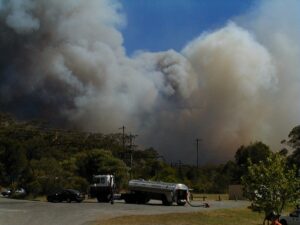

Is the fire danger in Dayboro going to be worse this year?
Lyndhurst Hill station · 20 years of data · 14 April 2026

The short answer, with the numbers behind it
Every year around this time someone asks me whether the coming dry season will be a bad one for fire. Fair question. I've been watching this valley since 2004 and the honest answer this year is: not worse than average on the forest side, but worth taking seriously on the grass side. Not catastrophic. Not benign. A "walk the fence line, do your slashing now" kind of year.
Here's what the data from Lyndhurst Hill shows, why I think the next six months deserve some attention, and what is actually worth doing about it on a Dayboro block.
What 2026 looks like so far (Jan to 14 April)
Rainfall at the Lyndhurst Hill station for 1 January to 14 April 2026: 513.6 mm. The 20 year mean for the same window is 719.1 mm. So we're running 28.6% below average.
Out of the 17 years where I have a complete January to-mid April record, 2026 ranks 11th wettest, meaning 10 years were wetter, 6 were drier. It's not a record dry start. But it's noticeably drier than the last couple of years (2025 gave us 1128 mm in the same window, 2024 was 912 mm).
The last 30 days in particular have been dry, 31.6 mm only. The 7 day forecast shows zero rain, and daily maxes climbing into the high 20s and low 30s through next week. That's classic autumn "high pressure sits over the east coast and does nothing for three weeks" weather. It's how our dry season usually starts.
The part most people miss: fuel load
Whether a year is a bad fire year isn't just about how dry it is right now. It's about how much stuff there is to burn, and whether it's dried out yet.
Two big wet seasons in a row grew a lot of grass
2024/25 wet season (Oct 2024 to Mar 2025): 1,698 mm, well above normal
2025/26 wet season (Oct 2025 to Mar 2026): 964 mm, below normal, but on top of the previous year
Two wet years = paddocks that grew heavy. One dry season after two wet ones = all that grass now curing in the sun. That's the setup fire ecologists describe as "fuel driven" conditions: the fire risk isn't about forest drought, it's about grassland ready to carry a spark.
For context, my Keetch-Byram Drought Index (KBDI) at Lyndhurst Hill is sitting at 37 on a 0-200 scale. Low. The soil profile isn't dry yet. My soil moisture at 10cm depth has been reading an average of 42 cb (centibars) over the last week, adequate, not stressed. So the forest floor isn't bone dry. But the grass on top is a different story.
That's why this needs to be read as a grassfire year, not a forestfire year. It's not the same risk profile as 2019.
What the big picture climate drivers say
Two numbers locals can check for themselves:
1. ENSO (El Niño / La Niña)
The 2025-26 La Niña has ended. We're in ENSO neutral right now (Niño 3.4 at −0.42 °C as of late March, per BoM). BoM's model ensemble points to warming through winter, possibly crossing into El Niño by late winter 2026. El Niño in spring/early summer historically means drier than average for eastern Australia.
2. BoM May–July 2026 rainfall outlook
For much of eastern Australia including southeast Queensland, the Bureau's three month outlook gives a 60% to over 80% chance of below average rainfall. That's a confident signal compared to a lot of past outlooks where the probability sat around 50-60%.
Put the two together: the landscape is drying out, and the official outlook says the next three months are more likely to be drier than wetter.
What the national outlook says specifically about QLD
This is the part where honesty matters. The AFAC Seasonal Bushfire Outlook for Autumn 2026 (that's the national fire authority body) flagged heightened fire risk for parts of NSW, Victoria, southeast South Australia and southern WA. Queensland, and specifically the southeast, was not flagged as above normal risk in the autumn outlook.
So the question "is it going to be catastrophic this year" has a pretty clear answer: no one who looks at this professionally is predicting that for our patch. Dayboro is classed as normal fire potential for autumn 2026.
But "normal" in this country still includes grass fires, paddock fires, and the odd nasty wind day. Normal doesn't mean nothing.
What happened on 12 April that's worth knowing about

Just a data point from my own station. On Sunday 12 April at 1:30pm, my Lyndhurst Hill setup recorded 32.2 °C with humidity dropping to 30% and light north westerly winds. In my view those are textbook grassfire ignition conditions. If the wind had been 25 km/h instead of 6 km/h, I reckon that afternoon would have been risky in a cured paddock.
It wasn't a dangerous day in practice, winds stayed light. But it's a reminder that the inputs are already lining up, in my read. Hot, low humidity, dry grass. On this moment we just don't have strong winds with it yet.
What actually matters now (before the dry season proper)
Fire preparation works best when it's done six weeks before you need it, not the weekend before. Here's the realistic prep hierarchy for a Dayboro property, from "whole of-acreage" to "house and-yard".
If you've got acreage and haven't slashed recently
This is where the work matters most and this year. If you've got more than a hectare or so with unmanaged grass, lantana, regrowth, or scrub, the window to get it done is April–May. After June the grass has cured further and slashing becomes a spark risk in itself on hot days.
For bigger blocks with serious regrowth, thick lantana, or ground that needs a firebreak put in under the government vegetation codes, I'd point you at Full Force Contracting. They run proper forestry mulching equipment (the stuff that clears heavy vegetation without burning or excavating) and they do fire breaks and hazard reduction as a specific service. Mitchell's number is 0480 180 502 and email is Mitchell@fullforce group.com. If you've been putting off clearing that paddock for five years because it needs machinery most contractors don't own, this is the call that solves it. Their gear leaves the ground clean and usable, not a churned up mess.

If you've got steep country or hillside paddocks
Hillside slashing is a specialist job. Most mowers can't or won't do it safely. Montgomery Contracting out of Laceys Creek specifically does hillside mowing and slashing, plus forestry mulching, lantana clearing and fire breaks. If your block sits on a slope (and plenty around here do) ring them on 04 9786 9057.
If you need paddock slashing on standard acreage
For regular paddock work on flatter country, Dayboro Slashing out of Mt Pleasant does mowing, slashing and light clearing across the Dayboro district. 04 0932 7452. Straightforward local operator.
If you're on residential acreage and just need it tidy
For acreage that doesn't need heavy machinery (the standard 1 to 5 ha block with lawn, some longer grass, hedges and a few trees) BES Acreage & Garden Services out of Samsonvale runs 24hp and 60hp zero turn diesel mowers. They also do brush cutting, weed spraying, hedges, and they sell firewood if you're thinking ahead to winter. 0429 489 900.
If you're on a house block in town
For a residential size yard, Todd's Total Mowing & Garden Care out of Mount Pleasant handles standard mowing, edging, hedge trimming, gutter cleaning and rubbish removal. Gutter cleaning is the one people forget. From what I've seen, dry leaves in gutters are a real housefire risk during a bad ember day. 04 8896 6660.
A practical checklist if you're on acreage
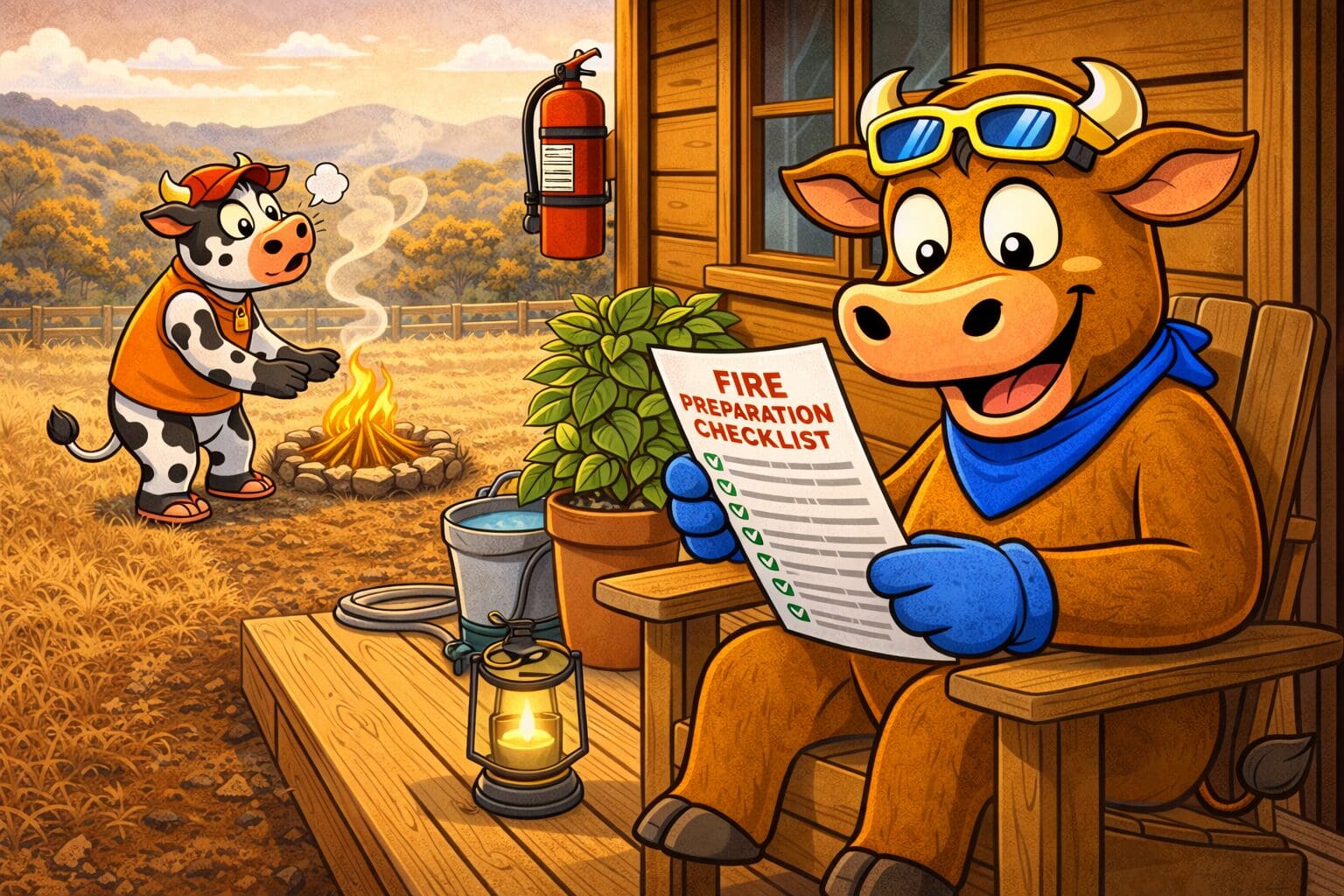
This isn't a panic list. In my view, these are the things that, if done by end of May, actually reduce your risk:
- Slash the grass within 30–50 metres of any dwelling or shed. Short grass doesn't carry fire well. This is the single biggest lever.
- Clear leaf litter from gutters and roof valleys. Gutter fires from embers cause more house losses than direct flame fronts.
- Move firewood stacks away from the house. 10 metres minimum, ideally more.
- Clear flammable vegetation away from gas bottles and under decks.
- Walk your fence line and note where a firebreak would go if you ever needed one. Knowing is most of the work.
- Check your bushfire survival plan. Queensland Fire Department has a template. If you don't have one, write one this month.
- Agree with your household who does what if a warning comes through. Roles, vehicles, where you go. Five minutes of conversation on a Sunday afternoon, no drama.
None of this is new advice. The reason I'm writing it down this year rather than last year is the fuel load-plus dry-outlook combination, as I see it. Last year the ground was so wet you couldn't have lit a paddock if you tried. This year, from what I'm seeing on my own station, the grass has grown tall, is drying out, and the outlook says the next three months will keep drying. I've been waiting on a rain event that keeps not arriving.
What I'd watch over the next three months
A few local signals that tell you whether things are shifting from "normal" toward "worth paying attention":
- KBDI above 80. At that point, in my read, the soil profile is drought stressed and even forest fuels start to become a problem. Right now we're at 37. I'll post if it climbs.
- A run of afternoons with humidity under 25% and winds over 25 km/h. Those are the days that matter. One of them with a spark in cured grass goes fast.
- BoM updates to the outlook. The May–July outlook is already pointing drier. If the August–October outlook confirms, that's a signal the back end of the dry season (when fires actually happen here) will be raised.
I'll keep my fireweather page on dayboro.au updated with my station's live FFDI and KBDI values. My members get the full 14 day trend and my interpretation of it. For people who want the raw numbers, my weather data is public.
Bottom line
2026 is shaping up as a normal to-slightly raised grassfire year for Dayboro. Not a record year. Not a catastrophe year. The data so far doesn't support hype, and the national outlook doesn't flag southeast Queensland. But abotu the only thing worse than panicking about fire risk is ignoring a setup that clearly rewards the few hours of prep that most of us put off.
If you've been meaning to get the paddock slashed, now is the window. If you've been waiting on a reason to ring someone about that lantana patch, this is the reason. If you've been meaning to clean the gutters, the next dry Saturday is the time. Most of the work takes one day. Most of the risk reduction comes form one day's work.
That's the whole thing.
Data sources: Lyndhurst Hill Dayboro weather station (private, Ecowitt GW2000, 2005–present, 6.5 million observation rows in WeeWX archive); BoM ENSO Wrap Up (issued 29 March 2026); BoM Climate Outlook May–July 2026; AFAC Seasonal Bushfire Outlook Autumn 2026.
If you want the 14 day fireweather trend for your property, the weather hub and membership dashboard give the full dataset.
Get Dayboro weather delivered to your inbox every morning: forecasts, garden tips, and local updates. Subscribe free →