
$16 Lettuce, $10 Tomatoes, and $36 Garlic. Your Grocery Bill Isn't Coming Down Anytime Soon.
Published: 4 April 2026 | Data source: dayboro.au Vegetable Price Tracker, Woolworths, Coles, Aldi, IGA (Brisbane) | Last updated: 3 April 2026
I've been tracking vegetable prices across four Brisbane supermarkets since July last year. Every day, the system logs what Woolworths, Coles, Aldi, and IGA charge for 76 different products. That's over 100,000 price records now.
And right now, I see the data telling a story that's hard to ignore.
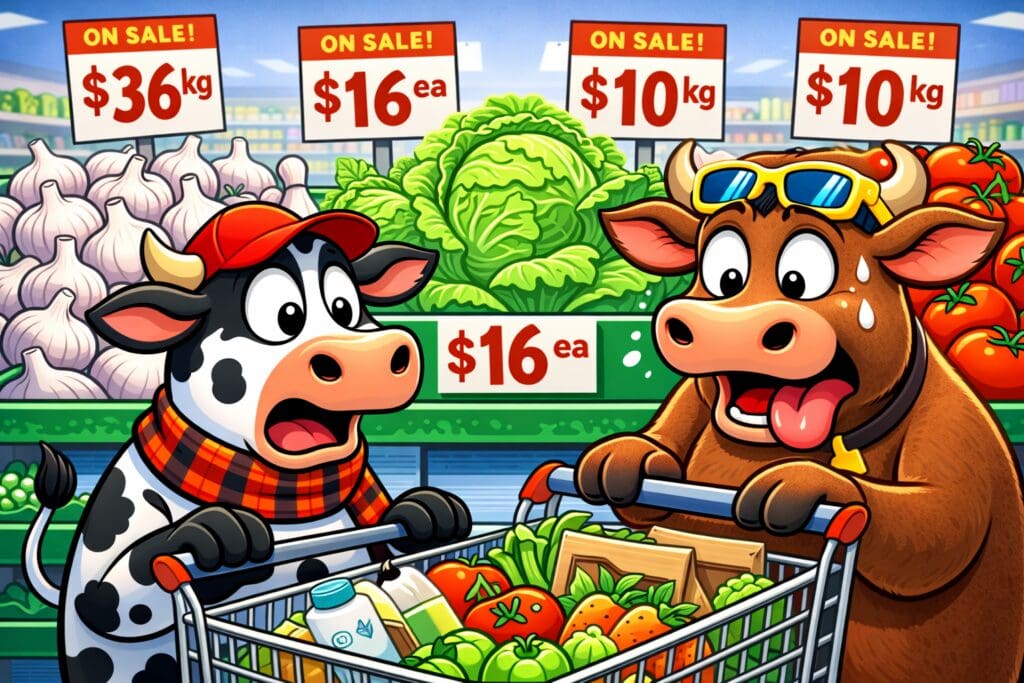
Tomatoes are sitting at $10.15 per kilo, up 26% in just the last month. Lettuce is $16.23/kg. At Woolworths specifically, it's $22.50/kg. Garlic? $35.73/kg. Ginger is $35.16/kg. Snow peas hit $19.96/kg, up 41% since October.
These aren't guesses. These are the actual prices logged yesterday from actual Brisbane stores.
What the Price Tracker Shows Right Now
Here's a snapshot from teh database as of 3 April 2026. These are average prices across all retailers that had stock:
| Vegetable | Now ($/kg) | 1 Month Ago | 6 Months Ago | Change (6mo) |
|---|---|---|---|---|
| Garlic | $35.73 | $35.68 | $57.74 | ▼ 38% |
| Ginger | $35.16 | $31.40 | $29.00 | ▲ 21% |
| Snow Peas | $19.96 | $21.96 | $14.13 | ▲ 41% |
| Lettuce | $16.23 | $12.96 | $14.03 | ▲ 16% |
| Spinach | $15.42 | $15.42 | $15.97 | ● -3% |
| Pak Choy | $13.73 | $13.48 | $9.64 | ▲ 42% |
| Parsnip | $13.84 | $13.60 | $11.60 | ▲ 19% |
| Tomato | $10.15 | $8.05 | $12.30 | ● -17% |
| Capsicum | $9.68 | $10.46 | $13.70 | ▼ 29% |
| Eggplant | $9.44 | $7.12 | $10.26 | ● -8% |
| Apple | $7.74 | $7.52 | $6.06 | ▲ 28% |
| Cucumber | $7.46 | $6.95 | $7.93 | ● -6% |
| Potato | $4.08 | $3.91 | $4.08 | ● 0% |
| Carrot | $2.65 | $2.65 | $2.23 | ▲ 19% |
Source: dayboro.au Vegetable Price Tracker. Prices are averages across all retailers with stock on 3 April 2026. Some items are only stocked by 1-2 retailers on any given day.
A few things jump out at me. Tomatoes climbed 26% in a single month. Eggplant is up 33% in the same period. Pak choy has risen 42% since October. And ginger keeps grinding higher, up 21% in six months, now sitting above $35 a kilo.
But here's what concerns me more than the current numbers: the reasons behind them aren't going away anytime soon.
Three Weather Disasters Hit Three Growing Regions
Australia's vegetable supply chain runs on a handful of regions. When one gets hit, I feel it at the checkout and so do you. In 2026, three got hit inside two months.
1. Bundaberg Flooding, March 2026
Tropical Low 29U crossed the coast between Gladstone and Bundaberg on 10 March. Some areas copped 350mm in 24 hours. The Burnett River hit 7 metres. More than 2,000 households lost power. Evacuations across Bundaberg North, South, East and Central.
Why this matters for your groceries: the Bundaberg Bowen corridor produces roughly 13% of Australia's perishable vegetable supply. In normal years, the Bowen area alone grows 33% of Australia's fresh beans, 46% of capsicum, and 23% of fresh tomatoes. That supply is now disrupted. Crops don't recover in a week. Replanting, regrowth, and getting back to harvest takes months.
2. Carnarvon Heatwave + Cyclone, January February 2026
Carnarvon in Western Australia recorded 47.9°C on 21 January, its hottest day on record. Three consecutive days above 40°C burned crops and caused widespread fruit drop. Then, barely two weeks later, ex Tropical Cyclone Mitchell came through with 107 km/h gusts.
The double blow was devastating. Banana growers reported losses of 20 to 60% across farms. Tomato seedlings were wind blasted beyond recovery. Growers estimate 12 to 18 months before banana supply returns to normal. Not weeks. Months.
3. Stanthorpe Hail, January 2026
BOM recorded hailstones of 6 to 8 centimetres in the Stanthorpe region with wind gusts of 107 km/h. Multiple producers in Dalveen, Applethorpe, and Pozieres were approaching their first harvest when the storm hit. At least one grower lost thier entire season's yield.
All of Queensland's apple crop is grown around Stanthorpe. The harvest window runs February to May. That storm hit at the worst possible time.
Our price data confirms it: apples are at $7.74/kg, up 28% in six months. That's not random. That's Stanthorpe.
Then There's the Fuel Problem
As if crop damage wasn't enough, getting food from farm to shelf just got a lot more expensive.
Diesel prices have surged roughly 40% since late February. Sydney diesel hit $3.22 per litre. South Australia crossed the $3 mark. The cause: Iran closed the Strait of Hormuz following military action, disrupting global oil supply.
Fuel makes up 20 to 30% of road freight costs. A B double run from Sydney to Melbourne now costs over $1,300 in fuel alone, up from about $900 six months ago. That extra cost doesn't disappear. It lands on the shelf price.
The human cost is worse. In Robinvale, Victoria, right in the Murray fruit belt, the local service station ran completely dry. The owner said in 25 years he'd never seen anything like it. MP Bob Katter reported farmers are letting fruit rot because the cost of picking and trucking to market no longer stacks up.
The government halved the fuel excise from 1 April. That helps a bit. But it's temporary, it runs until 30 June, and it doesn't fix the underlying supply disruption. We're still waiting on the Strait of Hormuz to reopen.
Where Prices Are Heading: An Honest Assessment
I'm not going to make numbers up. But based on the evidence I've verified, crop damage timelines, supply region disruption, transport costs, and BOM's temperature outlook, here's what the data points toward:
Tomatoes, Capsicum, Beans, Expect prices to stay raised or rise further through winter. The Bundaberg Bowen corridor that supplies nearly half our capsicum and a quarter of our tomatoes is still in recovery. Replanting to harvest is a 2-3 month cycle minimum. Our tracker already shows tomatoes jumping 26% in March alone.
Bananas, The Carnarvon growers themselves say 12 to 18 months for supply to normalise. North Queensland production can partially offset this, but WA supply is a significant part of the national picture. Prices are likely to climb from current levels.
Apples, Queensland's entire apple crop grows around Stanthorpe, and the January hail wiped out some producers completely. The harvest season (Feb May) is underway now with reduced supply. At $7.74/kg and rising, this is not going to correct until next season.
Leafy Greens (Lettuce, Spinach, Pak Choy), These are already expensive ($15-16/kg) and they're the most weather sensitive crops in the chain. BOM is forecasting above average temperatures across southern Australia through June. Any additional weather event in the Lockyer Valley or Werribee growing regions would push prices higher. Lettuce at Woolworths is already $22.50/kg.
Everything transported long distance, Even if crop supply recovers, diesel at $3+/litre adds a transport premium to every item that travels from farm to distribution centre to store. The fuel excise cut expires 30 June. Unless the Strait of Hormuz situation resolves, that premium stays.
The bottom line: The ABS already shows food prices up 3.1% annually to February 2026, and that was before the Bundaberg flooding and the worst of the fuel crisis. The average Australian household now spends $178 per week on groceries, up 11% from 2023. The next 3-6 months will add to that.
What You Can Actually Do About It
This is the part where most articles I read say "shop around" or "buy in season." That's not wrong, but it's not enough when the base price of everything is climbing. Here are three things I reckon actually make a dent.
1. Grow the Expensive Stuff Yourself
Not everything. You don't need to become a market gardener. But look at the prices and ask: what's expensive, what grows easily in South East Queensland, and what gives you the biggest return per square metre?
Here's what my maths looks like using today's supermarket prices:
| Crop | Store Price | Difficulty | When to Plant (SEQ) |
|---|---|---|---|
| Herbs (basil, mint, coriander) | $21-$32/kg | Dead easy | Year round |
| Chilli peppers | $28.81/kg | Easy | Sep Jan |
| Snow peas | $19.96/kg | Easy | Mar Jul (now!) |
| Lettuce | $16.23/kg | Easy | Mar Sep |
| Spinach | $15.42/kg | Easy | Mar Aug (now!) |
| Tomato | $10.15/kg | Moderate | Aug Feb |
| Capsicum | $9.68/kg | Moderate | Sep Jan |
| Eggplant | $9.44/kg | Moderate | Sep Jan |
A single basil plant I buy costs $4 from the nursery and produces roughly $50 worth of basil at store prices over a season. A few lettuce seedlings in succession planting, one tray every two weeks, can keep my household in salad greens for months. At $16/kg, that's real money.
I reckon April is the perfect time to start in Dayboro. The humidity is backing off, the soil is still warm, and the autumn growing window for leafy greens and peas is wide open right now.
2. Know What You're Paying, Before You Shop
The price differences between retailers are staggering. On the same day, for the same product:
- Lettuce: Aldi $9.95/kg vs Woolworths $22.50/kg
- Capsicum: IGA $3.37/kg vs Aldi $15.59/kg
- Beetroot: IGA $1.00/kg vs Aldi $9.96/kg
- Sweet Corn: Woolworths $3.33/kg vs Aldi $12.48/kg
- Tomato: Woolworths $9.27/kg vs Aldi $14.95/kg
That's not a small difference. That's sometimes 3x or 4x the price for the same vegetable, same week. This is exactly why we built the price tracker, because knowing which retailer is cheapest today can save you $20-40 per shop.
Evening Market Intelligence, Every Day at 6pm
Members get the Evening Market Intelligence report delivered to their inbox every day at 6pm. It shows the latest vegetable prices across all four retailers, highlights the biggest movers, what went up, what dropped, and flags the best value picks for your next shop.
It's the same data that powers the tables in this article, but updated daily and formatted so you can check it on your phone before heading to the shops.
3. Start Growing Together
Here's something I've been thinking about for a while now, and the numbers just keep making the case stronger.
Not everyone has space for a veggie patch. Not everyone has the time, the knowledge, or the physical ability to maintain one. But most neighbourhoods have someone who grows more zucchini than they can eat, someone with a lemon tree dropping fruit on the ground, and someone with a spare raised bed that's sitting empty.
What if you connected those people?
That's the idea behind community food growing, and platforms like localbuddy.au are built exactly for this. Get together with your neighbours. Pool resources. Share seeds, share surplus, share knowledge. One household grows lettuce, another does tomatoes, a third handles herbs. Between you, nobody is paying $16/kg for lettuce or $32/kg for basil.
It's not a radical idea. It's what people did before supermarkets became the only option. And when supermarket prices look like this, maybe it's time to revisit that approach.
Some practical ways to start:
- Neighbourhood growing groups, even 3-4 households sharing surplus makes a difference
- Community gardens, check with your local council about available plots
- Seed and seedling swaps, cheaper than the garden centre and you get locally adapted varieties
- Skill sharing, someone who's been growing in this climate for 20 years is worth more than any YouTube video
- localbuddy.au, connect with growers and food sharers in your area
The Bigger Picture
Australia's food supply chain is more fragile than most people realise. A handful of growing regions supply the majority of our fresh vegetables. When one gets flooded, or hail damaged, or hit by a cyclone, and that is not unusual in this country, the prices move fast.
Add a fuel crisis on top, and the system really shows its cracks. Farmers letting fruit rot because transport costs exceed the crop's value. That's not a theoretical risk. That's happening right now in Robinvale.
I remember the 2022 east coast floods pushing lettuce to $12 a head. We're looking at $22.50/kg for lettuce at Woolworths right now. The pattern repeats because the underlying vulnerability, concentrated production regions plus long transport chains plus fuel dependency, hasn't changed.
The fuel excise cut helps in the short term. But it expires 30 June. The Strait of Hormuz situation is not resolved. BOM is forecasting above average temperatures into June. None of the structural pressures are easing.
To me, self sufficiency doesn't mean living off the grid. It means being less exposed when the next storm, flood, or fuel shock hits. Growing even a few of the high value items in my own patch, herbs, leafy greens, tomatoes, reduces my exposure to the parts of the supply chain that are most fragile.
And doing it together, with your neighbours and community, makes it more resilient, more practical, and honestly, more fun.
About this data: dayboro.au tracks vegetable prices daily across Woolworths, Coles, Aldi, and IGA in Brisbane. The database holds over 100,000 price records across 76 products since July 2025. Members receive the Evening Market Intelligence report at 6pm every day with the latest prices and trends. Weather events are sourced from BOM, Queensland Government disaster reports, and verified media coverage. All price data cited in this article was queried from the database on 3 April 2026.
Get Dayboro weather delivered to your inbox every morning — forecasts, garden tips, and local updates. Subscribe free →