This chapter is about looking further ahead: next month, next season and the next few years. It covers our weather guide, the Farmers Almanac and the pages behind them. It also tells you, in the pages’ own words, how far you can trust a long range forecast.
What “long range” means here
Our weather guide explains that we forecast in three layers, and each one has a different job:
- Long range uses the Inigo Jones method. These are monthly outlooks, published roughly a month in advance. They tell you the overall character of the month, not what happens day to day.
- Medium range is the Dayboro Model. It looks 7 to 10 days ahead and is updated daily. It gives you the timing within the month.
- Near term is the Bureau of Meteorology forecast for the next 1 to 3 days. The guide simply says: use them.
The guide says to read them in that order, not as choices against each other. It also says plainly that the three do not always agree. Chapter 3 covers the medium range and short range forecasts.
How much to trust it
Well, our own pages are honest about this, so here is what they say:
- Step 1 of the guide says the method gives “tendencies, not certainty”. A month forecast to be wetter than normal will not have rain every day.
- Step 1 also says the idea behind the cycles has not been proven to the standard of modern science. It is a pattern method, not a physics model.
- Step 7 says we do not give confidence percentages, because the data does not support that much precision.
- On the 5-Year page, the Inigo Jones reading was tested on 78 past seasons. It fell on the right side of normal 47 times in 100, where a coin toss gets 50. The page says it did no better than simply expecting a normal season.
- The same page says its climate driver reading currently does worse than just using the long term average, and to treat those outlooks as experimental.
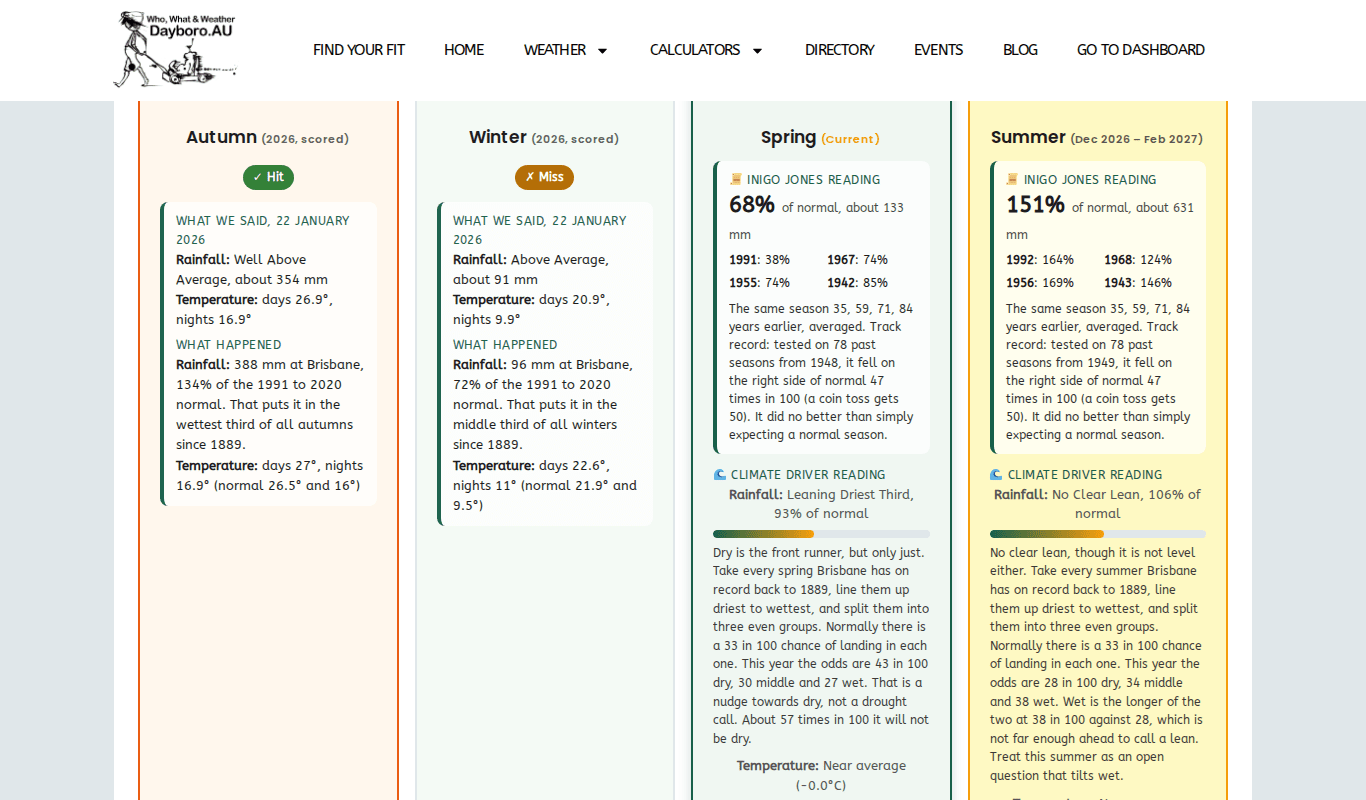
So use long range as a rough lean for planning, for example when to order feed or when to plant. Check it again a few times as the month gets closer. For anything inside 7 days, go to the 7 day forecast.
The weather guide and its 9 steps
The weather guide is the same for visitors and members. It sets out our whole long range method across nine step pages, from “Understanding the Basics” through to “Continuous Verification”.
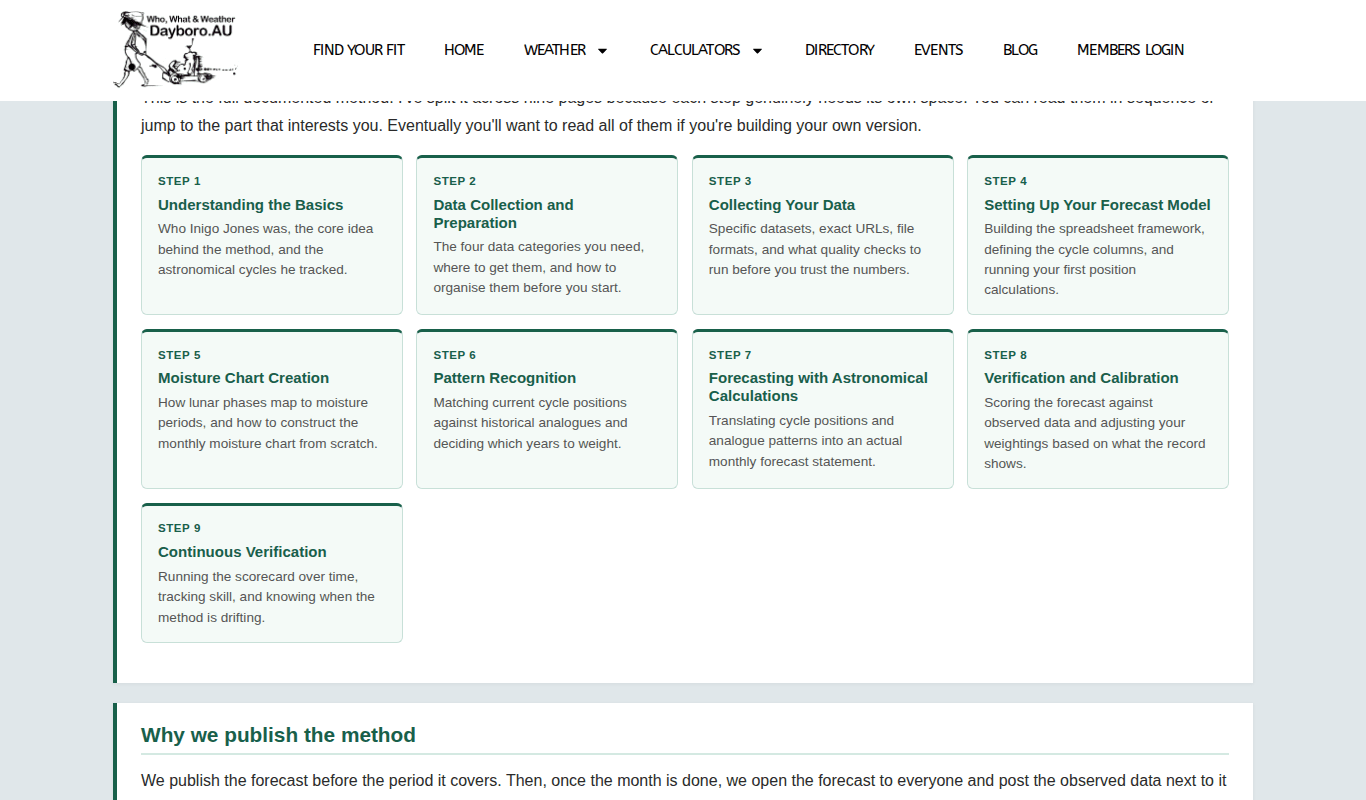
Step 1 is the best place to start. It explains who Inigo Jones was and which cycles he tracked. He ran a weather station at Crohamhurst, near Woodford, about 30 km from Dayboro. Steps 2 to 7 show how the forecast is built. Steps 8 and 9 show how each month is scored afterwards.
To move through the steps:
- Open the weather guide and click a step card.
- Each step page shows “Step N of 9” near the top.
- Use the step links to go forward or back, or “Back to Guide” to return to the list.
- Steps 5, 8 and 9 have comments. If you are logged in, you can add your own.
Monthly long range forecasts
The monthly forecasts sit on the Inigo Jones long range page. Members see the current month’s forecast before it starts. Once the month is over, the forecast is opened to everyone, next to what our station actually recorded. Each month gets a score, and good and bad months both stay on the accuracy page.
The Forecast Methodology page (members only)
The Forecast Methodology page shows the workings behind the almanac. Visitors only see a box inviting them to join, with links to the membership levels and to log in.
Members see the full page. It covers the data sources, the six cycles and where each one sits in 2026, ENSO tables, the adjustments we make for the Dayboro valley, a pest table, and how to use it alongside the monthly almanac pages. It opens with a note on limits: long range is not settled science, it is a planning framework and not a precise forecast, and the Bureau is the authority for anything inside 7 days.
The Farmers Almanac
The Farmers Almanac is a monthly guide for the garden and the farm. Tabs across the top pick the month. Visitors can open the months up to the current one. Later months show a lock.
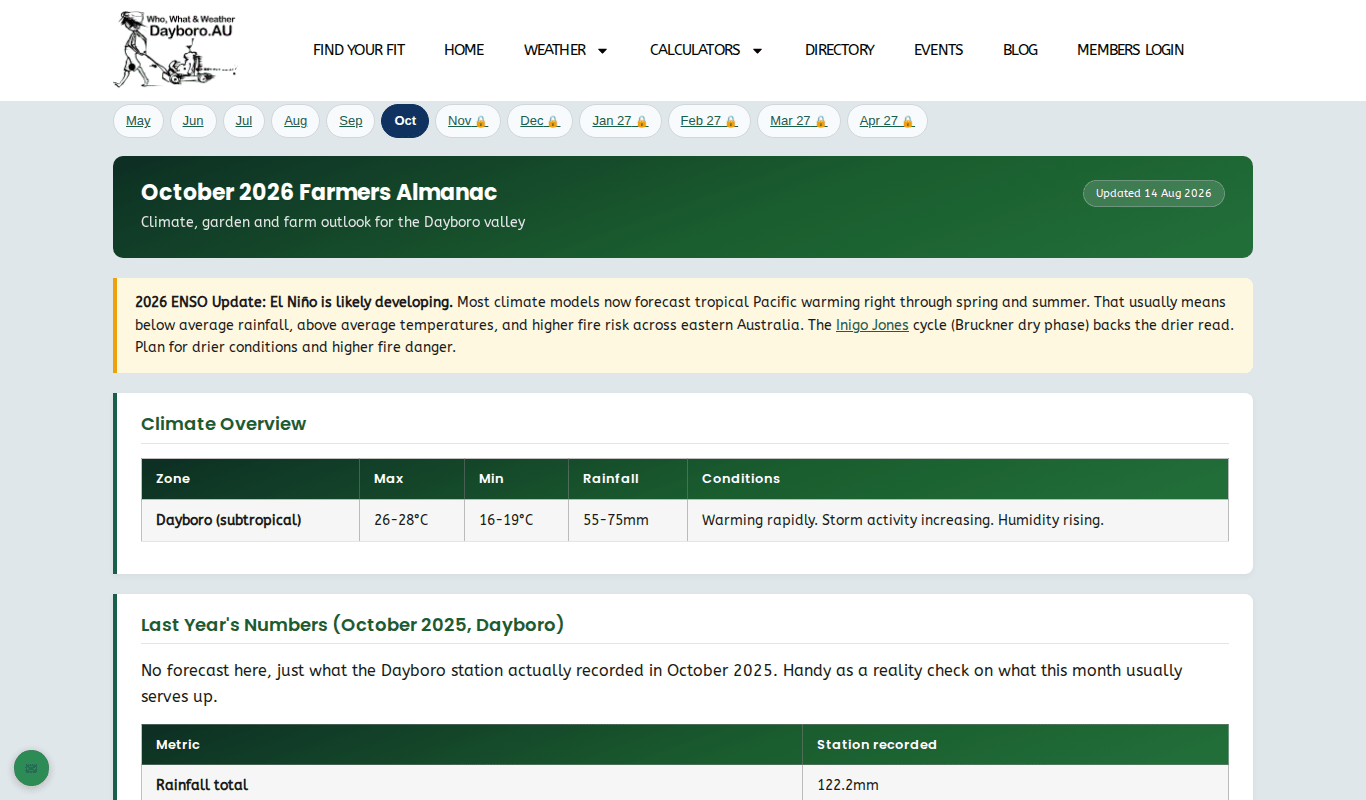
Every visitor sees:
- An ENSO update, with what it usually means for rain, heat and fire risk.
- A climate overview for the month: expected high, low, rainfall and conditions.
- Last year’s numbers: what our station actually recorded in the same month last year. This is a handy reality check.
- Astronomical events and moon phases.
Members also get sunrise and sunset times, a planting guide with what to plant now and what to harvest, a livestock guide for cattle, sheep and goats, poultry and bees, a self-sufficiency focus and key takeaways. They can also open every month ahead. See the membership levels to join.
Back to the guide contents. Next, chapter 5 covers weather history and climate.
The Dayboro team
Get Dayboro weather delivered to your inbox every morning: forecasts, garden tips, and local updates. Subscribe free →